
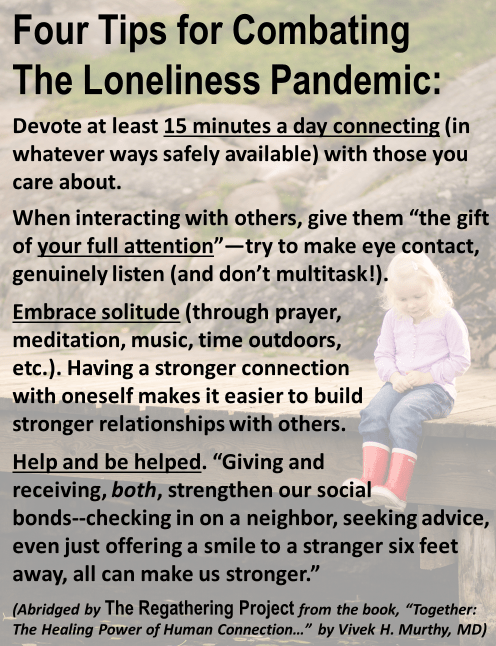
Dr. Vivek Murthy, in his book, “Together: The Healing Power of Human Connection in a Sometimes Lonely World,” offers four practical tips (see illustration above) for how we can begin to overcome loneliness, both in our lives and in the lives of others. We will briefly unpack each of these in a four-post series.
In his first tip, Dr. Murthy suggests we devote at least 15 minutes a day to connecting with those you care about. In our busy schedules, keeping in touch with others can easily get lost in the shuffle. Many of us could benefit from being more intentional and perhaps more structured in our relationship activities.
For those who are schedule-oriented, this tip might involve nothing more than blocking out time each day to call, text, visit or possibly write a note—whatever activities work best for you. For others, especially extreme introverts or extroverts, this suggestion could seem either daunting or too limiting.
For example, my extrovert wife, Kathy, is more spontaneous when connecting with others. When she has a lull in her day, she effortlessly picks up her phone for a quick call or to schedule a visit with a friend. For me, taking initiative in contacting others—especially over the phone—requires a significant act of will.
Beyond my relationships with God and Kathy, I must admit that connecting with others every day is still a work in progress. Instead of trying to achieve a time-based goal, I’m working toward doing one thing each day to connect or interact with someone else in a meaningful way. It might be engaging with the salesperson, cashier, or grocery bagger helping me at a store. It might be smiling or nodding hello to a stranger. Even written communication—sending a card with a note of appreciation, a text message, email, or a comment (even a “like”) on a friend’s social media post—can be a point for connection.
Even the smallest daily steps can lead to healthy long-term relationship habits.
To build better relationship habits, it’s more than okay to start small, for even the briefest effort might make a huge difference in someone’s day. Plus, research indicates that long-term habits are best developed and maintained by beginning with actions (often called mini habits), that can easily be completed on a daily basis. This creates the momentum needed to build toward larger-scale efforts.
I’m trying this mini-habit approach to connecting because I have recently seen fruit from that approach in other areas of my life. For example, despite the years of getting my work published, I’ve never managed to develop a consistent writing habit. Most of my work I completed with great effort because I had a deadline. My first step toward establishing a daily writing habit involved nothing more than setting a timer for eight minutes with a pen in hand or at the computer. By making my minimum writing goal small, I found I could fit it into even my busiest days.
Our loneliness pandemic won’t be eradicated overnight, but each day we can reach out to help at least one person feel a little less lonely. Over time, those small acts of love and connection will form the building blocks of a flourishing regathering movement. Join us!
Please share your examples and thoughts in the comment section below.
Patrick Klingaman
 The Regathering Project: Let's Transform the World, One Relationship at a Time